
Private George Kippling
PERSONAL INFORMATION
MILITARY INFORMATION
- Private, 78th Battalion, Infantry (Army).
- Private (Army).
Images

RESEARCH INFORMATION
George Kippling was born on 8 July 1887 in Rainy River. His parents were Edward and Margaret (Linklater) Kippling, both having roots in the Red River Settlement.
By the 1881 Canada census the couple was living in Eastern Extension of the Manitoba Extension of Manitoba, later to be part of Ontario. Listed as married, Edward's mother Mary (Waller) Kippling was also living with the family; likely his father Edward was away trapping. By the 1891 Canada census, they were living in the Western Division of District No. 46 Algoma in the province of Ontario. Family members included grandparents Edward and Mary, parents Edward and Margaret, and children Jane (Jennie), Dora, and George. Another child, Lillian, had been born on 17 May 1889 but died on 15 December 1890 of phthisis, a earlier term for tuberculosis of the lungs.
By the 1901 Canada census the family had moved to Rat Portage (later named Kenora). Death had taken a toll on the family: grandmother Mary had died 25 March 1893, daughter Mary born 29 July 1891 had died of whooping cough on 2 June 1895, George's mother Margaret died 30 August 1896, less than 3 weeks after giving birth to another daughter Eliza/Elizabeth born 11 August 1896 who died 17 September 1896, and Dora died 05 October 1900 of scrofula, tuberculosis of the neck lymph nodes. In the 1901 census family members were George's grandfather, his father Edward, sister Jennie, George, and a new sister, Hattie who was born 26 January 1894. Edward senior died 12 November 1906. On 4 December 1908, Jennie married David Folster, son of John and Jane (Sinclair) Folster. They gave birth to a son, Albert David Folster, on 19 August 1909 in Kenora, but Jennie died just over a year later on 17 November 1910 of tuberculosis of the lungs. By the 1911 Canada census, Edward was living on 2nd Street in Kenora, and Hattie was lodging at the Derry Hotel, occupation given as domestic.
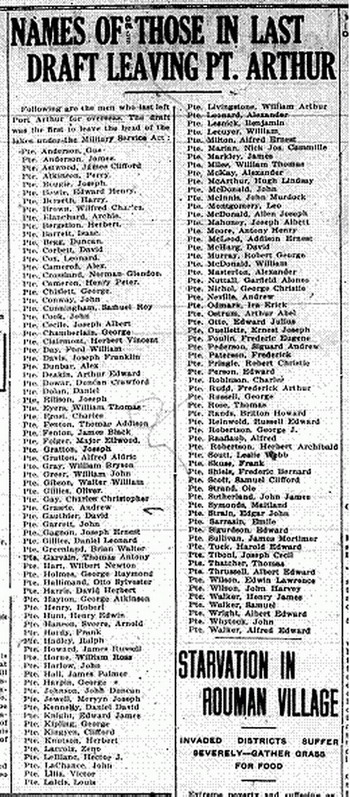
Although George had his medical examination in Sioux Lookout, Ontario, he signed his recruitment papers in Port Arthur, Ontario on 14 January 1918. According to an article of 16 February 1918 in the Port Arthur Daily News Chronicle, George had just recently left for overseas. Aboard the Cretic, Private George Kippling arrived in England on 4 March 1918, taken on strength with the 11th Reserve Battalion. On 21 June 1918 he was SOS to the 78th Battalion overseas. Once in France, George joined the 78th Battalion on 9 July 1918.
The 78th Battalion, also called the Winnipeg Grenadiers, was formed in response to the build up of forces for the offensive in 1916 to break through the German trenches. The battalion reached France by August 1916, and was then attached to the 12th infantry brigade of the newly formed 4th Canadian division of the Canadian Corps. During the Drocourt-Queant Phase of Sep 2-3, 1918 of Second Battle of Arras, the 1st and 4th Divisions led the charge, advancing behind a powerful artillery barrage. "In the centre, the 4th Canadian Division had also been fighting a hard battle between Dury and the main road, on the front trenches of the Drocourt-Quéant Line that were on a long exposed ridge of Mont Dury. Although the Germans had a topographical advantage that enabled them to fire and bomb from elevated positions, and despite their heavy losses, the Canadian battalions and the tanks reached the top of the ridge and drove the enemy back. The 4th Division had reached its first objective with the capture of Dury. During the night, the enemy pulled back, and on September 3, the Canadian Corps met no resistance when it advanced about six kilometres to take up positions facing the next obstacle, the Canal-du-Nord. In the first four days of September, the Canadian Corps captured more than 6,000 unwounded prisoners and inflicted heavy losses on the German Army. Its own casualties amounted to 5,600 men in this short period."
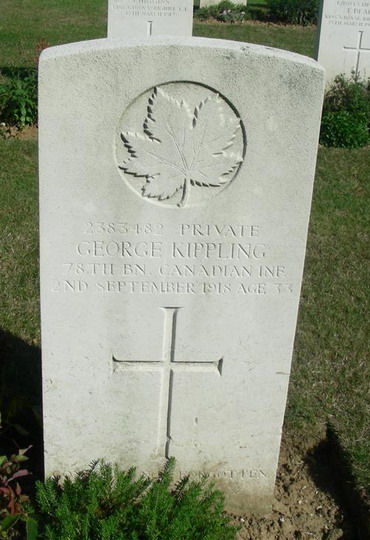
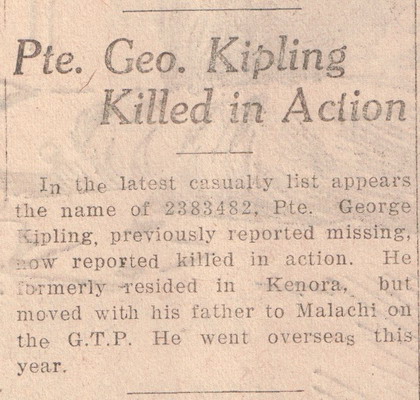
Private George Kippling was reported as missing and then as killed in action on 2 September 1918. From the CEF burial register for George: "Previously reported Wounded and Missing, now Killed in Action." His unit was taking part in the attack south of Dury at the time of his death. From the War Diary of the 78th Battalion, 2 September 1918: "The Battalion was in position by 3 am. Breakfast at 5 am. Battalion to be assembled in trenches ready to move at 5:30 am. The Battalion moved forward at 6 am." He is buried in the Beaurains Road Cemetery on the southern outskirts of Arras, north of the village of Beaurains.
George's sister Hattie married Hugh Phillip Weir, caretaker/superintendent of Minaki Lodge in Minaki, Ontario, on 30 March 1917 in Winnipeg. Their son, Alexander Cuthbert Weir, followed in his uncle's footsteps, serving as a Flight Sergeant (Air Gunner) for the 102 RAF Squadron in WW2. After taking part in a bombing raid on Stettin on 21 April 1943, the HAL DT747 crashed, burning not far from the Fisheries and Maritimes Museum in Esbjerg, Denmark. Alexander is buried in the Esbjerg (Fourfelt) Cemetery; he was only 26. George's nephew Albert Folster, age 4, died in Winnipeg on 31 March 1914. George's father Edward died in Kenora 23 February 1923. Over the course of his life he had worked as a trapper and trader, a fisherman, a boat builder, and latterly, as pump man for the Grand Trunk Pacific Railway, later known as the Canadian National Railway. His sister Hattie died in January 1973 and is interred in the Kippling family plot in the Lake of the Woods Cemetery, Kenora.
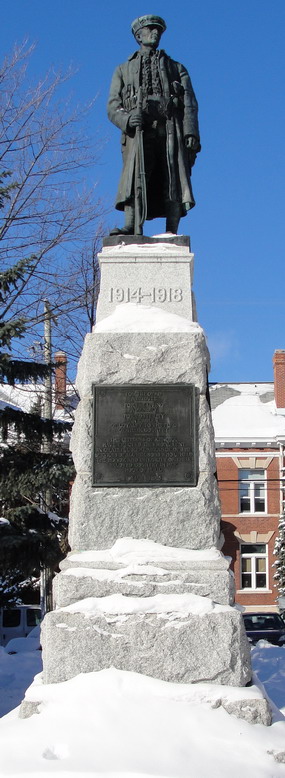
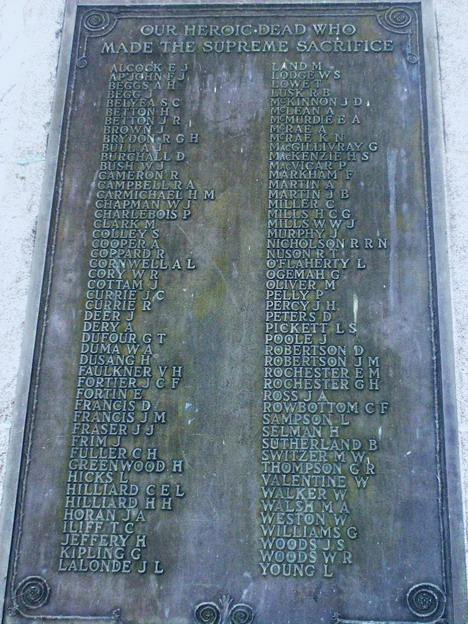
Private George Kippling is commemorated on page 442 of the First World War Book of Remembrance in Ottawa, on the Canadian National Railway Roll of Honour, on the Kenora Cenotaph, and the Kenora Legion War Memorial.
Surname spelling varied: found as both Kipling and Kippling
George's family is found listed on the Métis National Council Historical Online Database as well as in The Genealogy of the First Metis Nation, The Development and Dispersal of the Red River Settlement compiled by DN Sprague and RP Frye.
Although no birth record could be found for George, his birth date was not 1883 as given in his attestation papers; his sister Jane/Jennie was born 14 November 1883. Census documents confirm his birth as 8 July 1887.
Information about the 78th/4th Canadian Division from Library and Archives Canada: http://www.collectionscanada.gc.ca/firstworldwar/025005-1500-e.html
[Private Army Canadian Infantry 1st Depot Battalion, Manitoba Regiment Private Army Canadian Infantry 78th Battalion ]