
Private Ernest Bradley
PERSONAL INFORMATION
MILITARY INFORMATION
- Private, 15th Battalion, Infantry (Army).
- Private, 52nd Battalion, Infantry (Army).
- Private (Army).
War Service Badge Class A
Images

RESEARCH INFORMATION
Ernest Bradley was the son of Frederick James (Frank) Bradley and Elizabeth Ireland of Peterborough, England. He was born on 27 September 1886. His siblings were John (nickname - Jerry), Walter, and Frank. Ernest worked in England with the Great Northern Railroad, and when he immigrated to Canada in July of 1911 his intended occupation was listed as a railwayman. He made his way to Kenora, Ontario where other lads from Peterborough were already working for the railroad.
When WW1 broke out Ernest was working as a lineman for the CPR in Kenora. He enlisted on 23 December 1914 and joined the 52nd Battalion training in Kenora and then Port Arthur, Ontario. His unit embarked for England on 04 September 1915 aboard the Missanabie. Ernest was transferred to the 12th Reserve Battalion upon his arrival in England. In a letter back to Kenora in January of 1916 Ernest is identified as a “signaller” stationed in Shorncliffe. In June of 1916 he joined the 15th battalion in France.
During the First World War being a signaller usually meant you were close to the frontline troops, providing signals communications back to your Company and Battalion H.Q. Wired telephones were used where possible but this involved laying landlines which was a hazardous job due to enemy shelling. Where it was not possible to lay landlines then many forms of visual signalling were used which made use of light either from sunlight (use of the sun and mirrors) in day time and lamps at night (Lucas Lamps). Messages were sent in Morse code, one man operating the signalling device and one man using a telescope (where distances were great) to read the message sent back. Signallers were also used in forward positions to assist the artillery and provide information on their enemy targets. In these positions, often isolated, the signaller became vulnerable to enemy shelling and attack, and many signallers lost their lives.
Ernest spent two years ten months with the 15th battalion in France, attending the Canadian Corps Signaling School in January 1918. On 19 October 1918 he was granted permission to marry and given a two week leave to the UK. He travelled to Peterborough, England and married Phoebe Seaton sometime within his leave period. In February 1919 Ernest and his bride returned to Canada. His official discharge came on 04 July 1919 and was due to demobilization.
Phoebe and Ernest made their new home back in Kenora where Ernest worked once more for the C.P.R. In February of 1925 Ernest and Phoebe visited Peterborough, England returning in May of that year on the ship S.S. Montcalm. At this time Ernest was an engineer with the C.P.R. Their only child was baby Monica, born in Peterborough, England. They adopted her and brought back to live in Kenora.
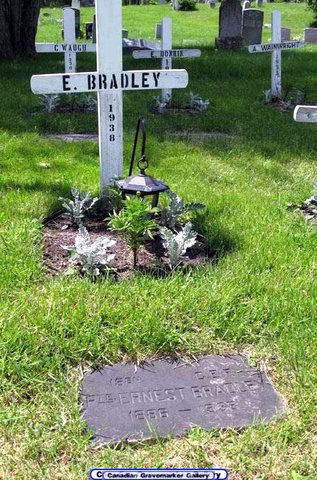
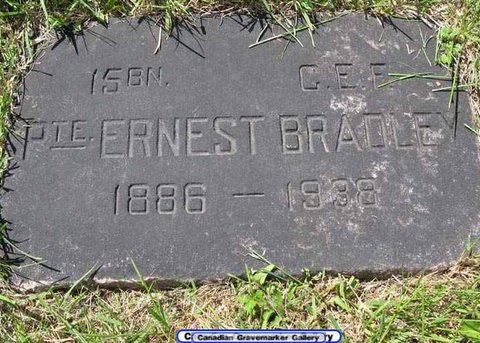
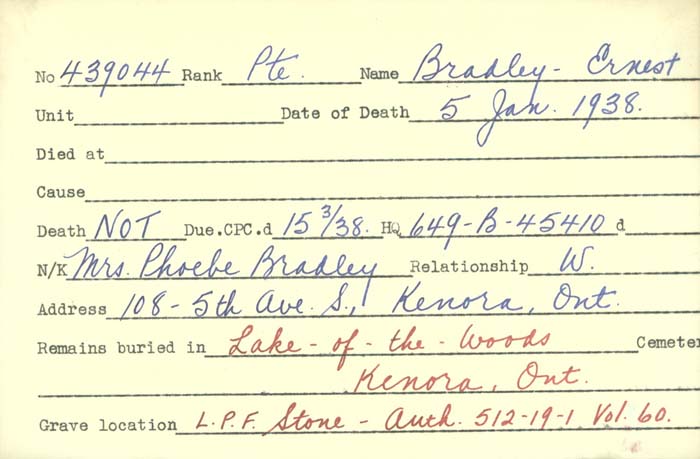
Unfortunately, Ernest passed away on 05 January 1938 at the age of 51. His obituary notes that Ernest came through the war without a wound but “the tremendous toll of long service proved too heavy a handicap and on his return he suffered from war services in shattered health and strength.” He is buried in Lake of the Woods Cemetery, Kenora.
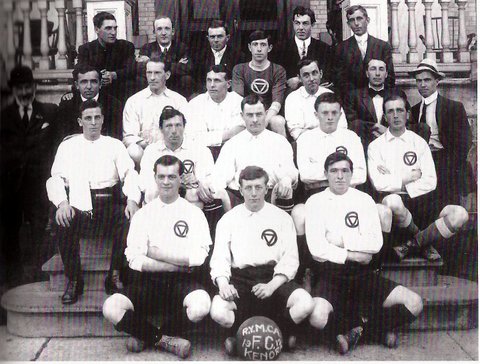
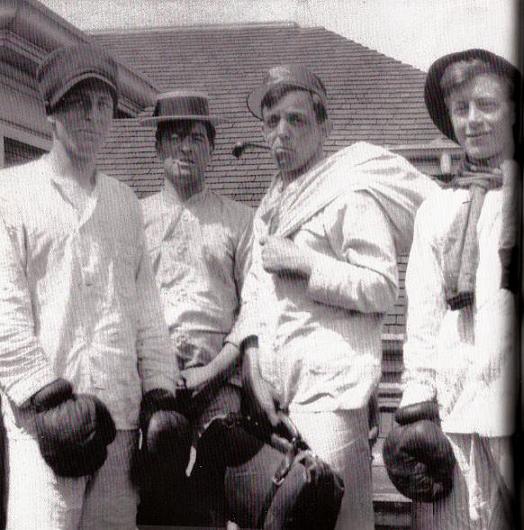
By the fall of 1938 Phoebe returned to England with her daughter Monica later returning to live in Kenora. Ernest’s brother, Frank, entered the war in England and was killed early in the war. His other brother, Walter, served in the war and survived. Ernest and Walter are featured in the story of 'The Peterborough Boys' by Stan Clark in the book Common Ground, Stories of the Lake of the Woods.
By Kenora Great War Project
Family members living in Kenora/Keewatin
Book: Common Ground: Stories of the Lake of the Woods 2006-2010 - The Peterborough Boys - by Stan Clark
ancestry.ca - 1891, 1901, 1911 Census of England
Canadian Passenger Lists - 1865-1935
The 52nd (New Ontario) Battalion, CEF
St. John The Evangelist Church, Thunder Bay - http://www.stjohnsthunderbay.ca/index.php?option=com_content&view=article&id=90&Itemid=108
Canadian Gravemarker Gallery
[Private Army Canadian Infantry 52nd Battalion Private Army Canadian Infantry 12th Reserve Battalion Private Army Canadian Infantry 15th Battalion War Service Badge Class A ]