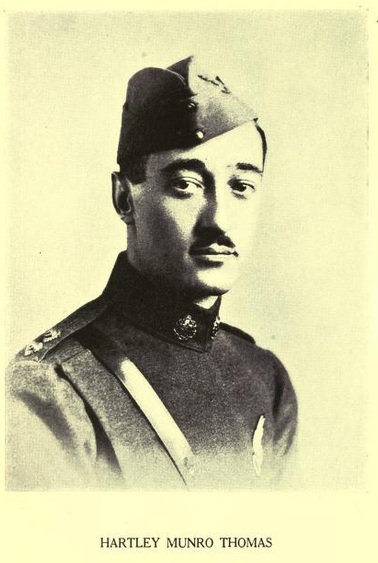
Lieutenant Hartley Munro Thomas
PERSONAL INFORMATION
MILITARY INFORMATION
- Lieutenant (Army).
- Lieutenant (Army).
- Lieutenant (Air Force).
Images
RESEARCH INFORMATION
Hartley Munro Thomas served in a succession of regiments and survived the war to become, ultimately, a Professor of History at the University of Western Ontario. His WWI poetry - still very much worth reading -was published in 1918 under the title "Songs of an Airman and other Poems." According to the Introduction to that work (by SW Dyde, Principal of Queen's Theological College, Kingston),
"When the war broke out young Hartley was just eighteen, and was taking an honors course in History and Political Science in Queen's University at Kingston. He enlisted immediately, only to find himself unfit. Thereupon he settled down to take his officer's training, and was at once given the position of war editor of the Regina Province. After this experience in journalism, he taught school in a settlement of Germans and Swedes in southern Saskatchewan until he became fit for service. Then going home to Vancouver, he was given a commission in the 131st Westminsters, and, at the outbreak of the Somme offensive, was one of a special draft of officers sent forward. Thus he served with the Western Scots, and in one of his last poems, The Pipes o' War, can be seen the pride he took in his Highland regiment. He was proud of Highland blood, and the tartans meant much to him. After the taking of Vimy Ridge he was transferred to the Royal Flying Corps, enthusiasm for which had long filled his letters. He was soon flying with Sir Julian Byng's army and shared in the adventures of the Cambrai offensive."