
Private Alexander Matier
PERSONAL INFORMATION
MILITARY INFORMATION
Private, 52nd Battalion, Infantry (Army).
Images
RESEARCH INFORMATION
Private Alexander Matier was wounded in May 1916, three months after arriving in France with the 52nd Battalion. He was invalided to Canada in June 1917 and he died in Winnipeg three years later.
Alexander was the son of Alexander Matier Sr. and his first wife Grace Ann Felt. Alexander Sr. had emigrated from Ireland when he was just a child and Grace was American, probably born in New York. They were married in Manhattan, New York City in 1872 and they had at least five children: Grace (1877), Alexander (5 January 1880), Gertrude (1882), and two others who died as infants. Alexander was born and raised in Manhattan, where his father worked as an upholsterer. His mother passed away in March 1885, at age 35, and the youngest child, daughter Edith, died three months later. Alexander Sr. married his second wife, Elizabeth Meehan, in 1889 or 1890. He had five more children with Elizabeth: Marguette (1890), Marie (1894), Agnes (1896), Richard (1897) and John Harold (1898). Both Marguette and Agnes died as infants.
Alexander enlisted with the U.S. National Guard in 1898, during the Spanish-American War. He was 18 years old at the time, 5'7" tall with blue eyes and brown hair. He was mustered in as a private in the 71st New York Regiment, Company E and he served in New York City and Cuba for six months, from May to November 1898. At the time of the 1900 census he was back at home, working as an upholsterer. His father died two years later, in December 1902, at age 54. When the 1910 census was taken Alexander was boarding with a family in Brooklyn, New York and working as a patrol policeman. After that he spent some time in Boston and while he was there an employment agent found him a job in Canada, working on the railway. By the time Alexander enlisted, in the spring of 1915, he was living in Kenora, Ontario.
The war started in August 1914 and by December a third overseas contingent was being raised. Alexander signed up in Kenora on 19 March 1915, joining the 52nd Overseas Battalion. He was working for the Canadian Pacific Railway at the time, his occupation was upholsterer and next of kin was his married sister, Mrs. Gertrude (Albert) Taddiken in New York City. The 52nd had been organized in Port Arthur and it was being recruited in towns throughout northwestern Ontario. In June the Kenora volunteers were sent to Port Arthur to train with the rest of the unit. Early in November they left for St John, New Brunswick, embarking from there on 23 November on the SS California. They spent three months training in England and on 20 February 1916 the battalion was sent to France. The men spent the first night in tents in a snowstorm before being moved to Belgium by train the next day. They became part of the 9th Infantry Brigade in the 3rd Canadian Division.
In the first week of March the 52nd went into the trenches for training and the unit suffered its first combat fatality on the night of 11-12 March. Later that month the Canadian Corps took up positions in the south part of the Ypres Salient, between St. Eloi and Hooge, and the 52nd was moved there on 1 April. During a rotation in the front line at Hooge Alexander volunteered to help a wounded man in a nearby post. He had a very close call when he encountered four Germans on the way. He suffered a slight bullet wound to his head but he escaped and was able to make it back to his trench after dark. He had taken a wiring course in March and at the end of April he volunteered to serve with the 3rd Division wiring party. The men worked at night, from 9 pm to 3 am, stringing barbed wire on the front line. On the evening of 19 May Alexander was in Ypres with his wiring party, getting ready to go to the front trenches, when a large artillery shell exploded nearby. He suffered a severe shrapnel wound to his left arm and his upper thigh and buttocks. He was able to crawl to the nearest first aid post and he was taken to No. 10 Casualty Clearing Station, where he had surgery. From there he was evacuated to No. 1 Canadian General Hospital in Étaples and by 25 May he was back in England.
Alexander spent the next eight months recovering in hospitals in the UK. He was a patient at the Northampton War Hospital in Duston until December, followed by a month at the War Hospital in Croydon and a week at the Canadian convalescent centre in Epsom. Between January and May 1917 he served with the Manitoba Regiment and the Garrison Depot, most of that time doing clerical work. On 11 May he was admitted to Granville Special Canadian Hospital and diagnosed with a lesion of the sciatic nerve, drop foot and atrophied calf muscles, all the result of his previous wound. He was invalided to Canada for further treatment, embarking on 18 June on the hospital ship Letitia.
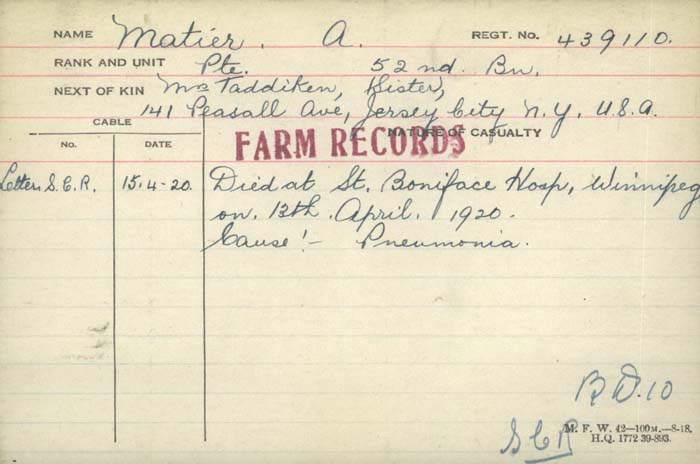
On 11 July 1917 Alexander was admitted to the Manitoba Military Convalescent Hospital in Winnipeg, where he was treated for the next 15 months. In September he had an operation at the Winnipeg General Hospital but he continued to suffer from drop foot and difficulty in walking. He was released from the hospital in early September 1918 and discharged on 20 September, due to being medically unfit for further war service. He was entitled to wear one gold bar (wound stripe). Alexander stayed in Winnipeg after his discharge, living at the YMCA and working as a clerk for R.J. Whitla, a dry goods wholesaler. He passed away in St. Boniface Hospital on 13 April 1920, at age 40, suffering from pneumonia. Next of kin was his sister Gertrude Taddiken in New York and Gertrude herself died two years later, also at age 40.
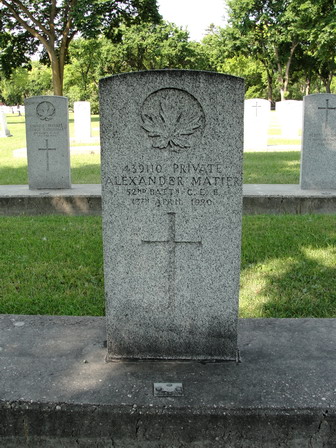
Alexander's death was considered to be due to service and he is commemorated by the Commonwealth War Graves Commission and on the Canadian Virtual War Memorial. He is buried in the Field of Honour at Brookside Cemetery in Winnipeg.
Alexander's attestation has his place of birth listed as Sudbury, Ontario but he was born in New York City (from Index to New York City births, census records, and U.S. military service record).
Transcripts of three letters written by Alexander are on the Canadian Letters and Images Project website here.