
Private Robert Bruce Lusk
PERSONAL INFORMATION
MILITARY INFORMATION
- Private (Army).
- Private, 52nd Battalion, Infantry (Army).
- Private (Army).
Images
RESEARCH INFORMATION
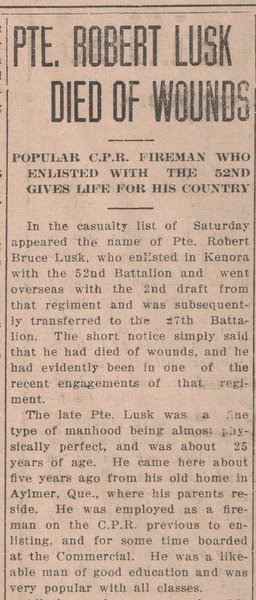
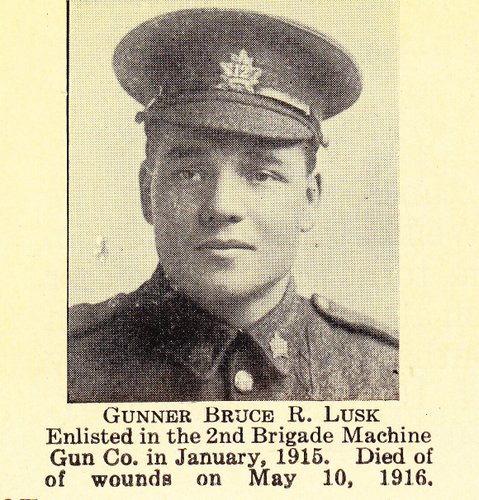
During the First World War more than 11,000 employees of the Canadian Pacific Railway Company enlisted for service and 1,116 of them gave their lives. Private Robert Bruce Lusk was working as a locomotive fireman for the CPR in Kenora, Ontario when he signed up in December 1914. He arrived in Belgium in March 1916 and died of wounds two months later.
Robert was the son of John and Elizabeth Lusk of Aylmer, Quebec. John and Elizabeth had at least twelve children and Robert, the youngest, was born on 17 March 1891. John was a farmer and for both the 1881 and 1891 censuses the family was listed in the township of Eardley, an area northwest of Ottawa on the Ottawa River. Robert's ancestors were Irish and they'd first settled in that part of Quebec in the early 1800s where they owned land, farmed and engaged in lumbering. The village of Luskville was named after them. By the time of the 1901 census Robert's parents had moved east to the township of Hull, Quebec and ten children were still living at home.
The war started in August 1914 and Robert enlisted four months later, on 21 December, when volunteers were being recruited for a third overseas contingent. He was 23 years old, living in Kenora, Ontario and working for the CPR. He said he had previous militia experience with the Royal Engineer Corps. He was listed as unmarried on his attestation paper but he'd actually been married for a couple of years and he had a daughter who was born in Saskatchewan in 1910.
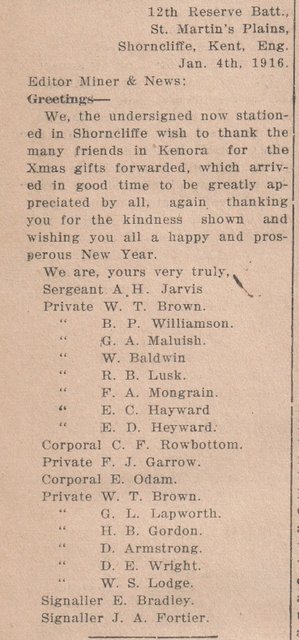
The Kenora recruits were briefly attached to the 44th Battalion but when the 52nd (New Ontario) Battalion was organized in mid-March they were transferred to the new unit. The 52nd was based in Port Arthur and Robert was sent there in June 1915 along with the rest of the Kenora volunteers. While they were training the 1st Canadian Division was fighting in France and Belgium. Men were needed to replace casualties in the front line units and battalions in Canada were asked to send reinforcements. Robert was sent to England with the 2nd Reinforcing Draft in September 1915, one of 250 men from the 52nd Battalion. They embarked from Montreal on 4 September on the SS Missanabie and arrived in England nine days later. Robert was transferred to the 12th Reserve Battalion for a few more months of training at Shorncliffe Camp in Kent and on 28 February 1916 he was assigned to the 2nd Canadian Brigade Machine Gun Company. He arrived at the Base Depot in France on 3 March and a short time later he joined his new unit in the field in Belgium.
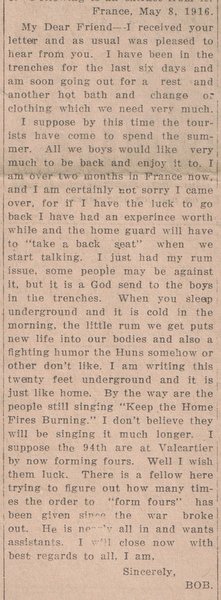
That spring the Canadians were in the Ypres Salient, holding the front line between Hooge and St. Eloi. The 2nd Machine Gun Company was undergoing training and the men also formed working parties to help construct dugouts and gun emplacements. In April they started doing rotations in the front trenches and on 2 May Robert's section was one of three that were sent to several positions in the front lines. In a letter to a friend dated 8 May Robert said he'd been in the trenches for six days and would soon be going out for a much needed rest. Later that same day, however, Robert was seriously wounded. He was evacuated to No. 17 Casualty Clearing Station where he died two days later, on 10 May.
From the War Diary of the 2nd Machine Gun Company, 8 May 1916: 1 O.R. 439034 Pte Lusk wounded seriously. 10 May 1916: 439034 Pte Lusk, wounded, died of wounds. From the Circumstances of Death record for Robert: Died of Wounds (Gunshot wound neck) at No. 17 Casualty Clearing Station.
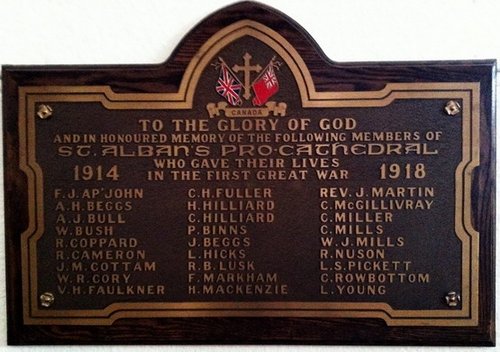
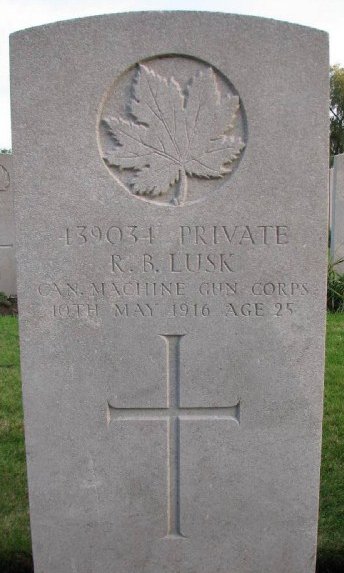
Robert is buried in Lijssenthoek Military Cemetery near the village of Poperinge in Belgium. Lijssenthoek is the second largest Commonwealth war cemetery in Belgium and it contains almost 10,000 Commonwealth burials. Robert is commemorated on the Kenora Cenotaph, the Kenora Legion War Memorial and the St. Alban's Pro-Cathedral Memorial plaque. Every year at 11 am on November 11th the CPR stops all of its trains in North America for two minutes of silence, to pay tribute to those who served their country.
Robert's sister Jessie served in England and France as a Nursing Sister during the war, and his brother Allan was conscripted in 1917 while he was living in BC. They both survived the war. Robert's cousin Andrew Lusk, who was also from Eardley, Quebec, enlisted in Fort Frances, Ontario in January 1915. He served with the 15th Battalion (48th Highlanders of Canada) and he was killed in action in France on 1 September 1918.
Robert's attestation paper has his birth year as 1890 but he was born in 1891; he was two months old when the 1891 census was taken (16 May 1891).
[Private Army Canadian Infantry 52nd Battalion Private Army Canadian Infantry 12th Reserve Battalion Private Army Canadian Machine Gun Corps 2nd Machine Gun Company ]