
Lance Corporal James Howard Percy
PERSONAL INFORMATION
MILITARY INFORMATION
- Private (Army). 1915-09-15 ?
- Lance Corporal, 31st Battalion, Infantry (Army).
Images
RESEARCH INFORMATION
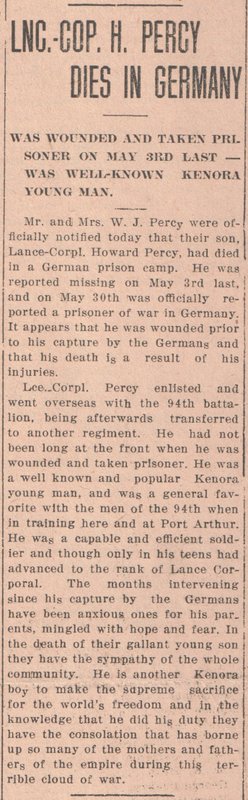
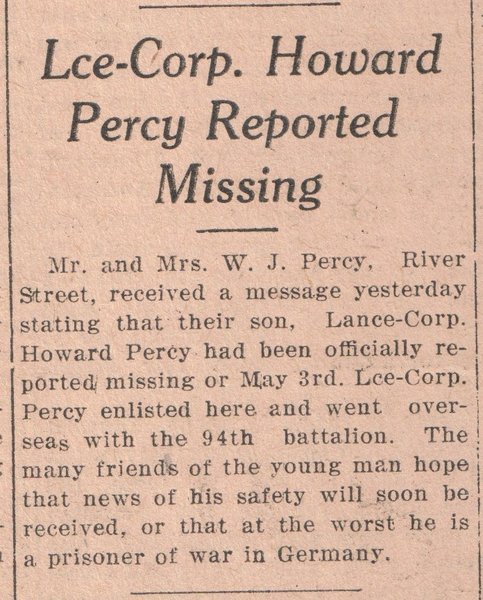
During the First World War about 3,800 Canadian soldiers became German prisoners of war. Lance Corporal James Howard Percy was sent to France in May 1916 and he was taken as a prisoner of war on 3 May 1917. He died a few days later in a German hospital.
Howard was the oldest child of William John Percy and Elizabeth Paul of Kenora, Ontario. William and Elizabeth were both born in Ontario and they were married in 1889 in Lanark County. Howard was born later that same year, the first of at least seven children - four sons (James Howard, William, John and Gordon) and three daughters (Mildred, Christina and Winnifred). The older children were born in Lanark County and Parry Sound. By the time of the 1901 census the family had moved to Rat Portage (later called Kenora) in northwestern Ontario, where William worked as a lumberman and miner. The three youngest children, William, John and Gordon, were born in Kenora. Sadly William drowned in 1909 at the age of four.
The war started in August 1914 and Howard enlisted a year later, signing up with the 45th Battalion on 15 September 1915 at Camp Sewell. Sewell was located just east of Brandon, Manitoba and it was renamed Camp Hughes later that year. The 45th Battalion trained in Manitoba during the winter and headed overseas in the spring, embarking from Halifax on 17 March 1916 on the SS Lapland. Howard spent six more weeks training in England. He was transferred to the 31st (Alberta) Battalion on 7 May 1916 and sent to France the next day. He joined his new battalion in Belgium on 2 June, in a draft of 100 men, and just three days later he found himself in the front trenches at the Battle of Mount Sorrel.
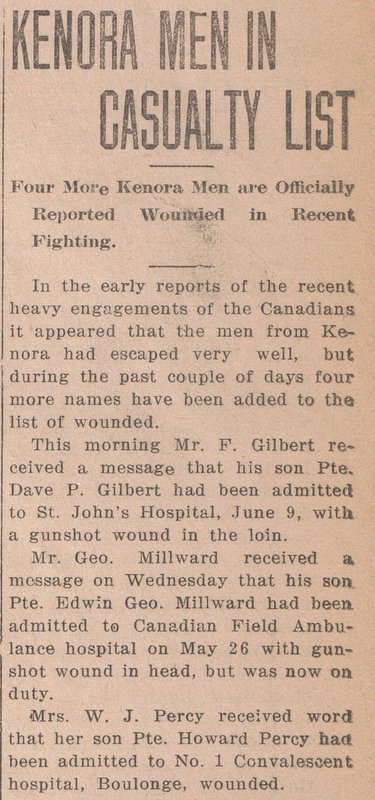
That spring the Canadians were in the south part of the Ypres Salient, holding the front line between Hooge and St. Eloi. The Battle of Mount Sorrel started on the morning of 2 June with a massive bombardment of the Canadian lines followed by the explosion of underground mines. Trenches and equipment were destroyed and some companies were almost wiped out. After the barrage German infantry advanced and captured Mount Sorrel and nearby areas. The 28th and 31st Battalions were brought forward on 5 June, to relieve units in the area between Hooge and Zouave Wood. On 6 June the Germans blew up more mines, this time near Hooge, and the 28th Battalion lost almost an entire company. After the explosions German infantry attacked but their advance was stopped by heavy rifle fire from the two Canadian units. The War Diary of the 31st Battalion listed 164 casualties in the three-day operation of 6-8 June. Howard was one of the wounded on 7 June, suffering injuries to his knees, ankles and neck. He recovered at a hospital in Boulogne, France and rejoined his unit three weeks later. In July a shoulder injury put him out of action for another three weeks. Starting in late August the Canadians were moved to the Somme area in France and the 31st took part in several operations there. By the time the Somme Offensive ended on 18 November the Canadian Corps had suffered over 24,000 casualties.
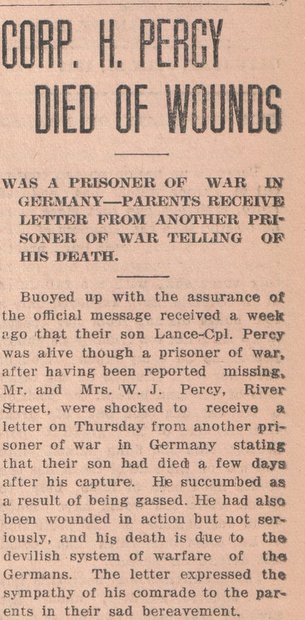
In December 1916 Howard was promoted to Lance Corporal and in the new year the 31st Battalion began training for the upcoming assault on Vimy Ridge (9-14 April 1917). The Battle of Vimy Ridge was the first time all four Canadian Divisions were used in one operation and the carefully planned attack was a remarkable success. Following the battle the 31st Battalion stayed in the area and took part in the capture of Fresnoy, a small hamlet east of Vimy. The operation began before dawn on the morning of 3 May. The Germans were expecting the assault and the Canadian assembly positions, visible under a full moon, were heavily shelled by German artillery. The 31st Battalion was on the left flank of the attacking line and the men ran into problems after only a short distance when they encountered uncut barbed wire. The battalion suffered heavy casualties that day, losing almost half of its strength, and Howard was one of several men captured by the Germans. He had apparently been wounded beforehand and he died six days later, on 9 May 1917, in a German prisoner of war hospital. His parents learned of his death in a letter from a fellow soldier. They received the letter on 19 July 1917 and they were officially notified of their son's death three months later, on 24 October.
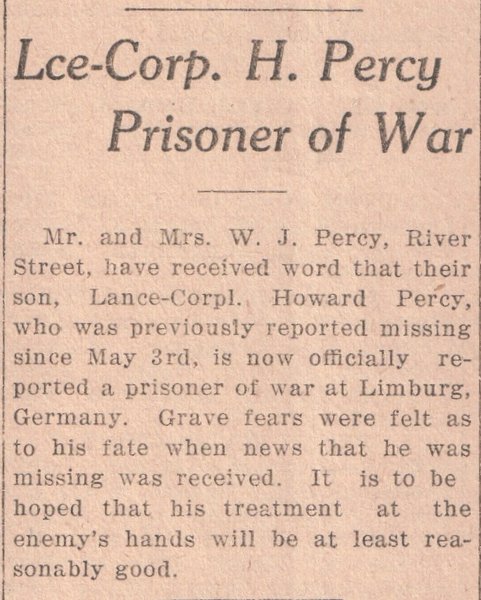
From the Commonwealth War Grave register for Howard: Previously reported. P.O.W. at Limburg now reported died whilst P.O.W. at Aachen.
From his Circumstances of Death record: "Previously reported Died, (through German sources) Whilst Prisoner of War, now for official purposes presumed to have died whilst Prisoner of War at Reserve Lazarett at Aachen." A lazarett was a German military hospital for prisoners of war and Aachen is located on Germany's border with Belgium.
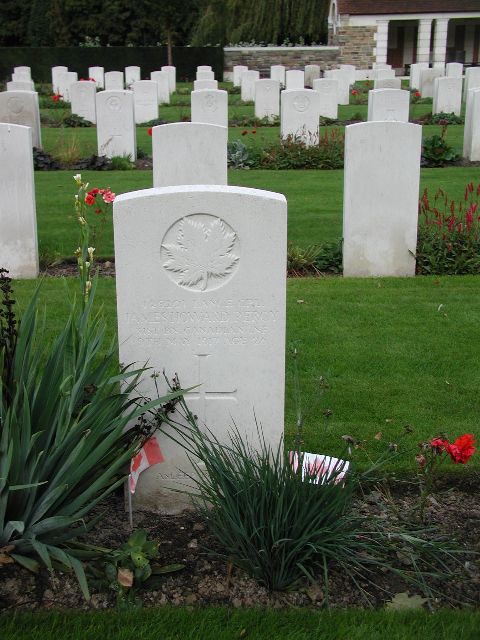
Howard is buried in Plot X of Brussels Town Cemetery in Brussels, Belgium. The plot contains the graves of 54 Commonwealth casualties, 50 of them prisoners of war who were re-interred there by the Canadian Corps in April 1919. Howard is commemorated on the Cenotaph in Kenora, Ontario, on the Kenora Legion War Memorial and on page 308 of Canada's First World War Book of Remembrance, displayed in the Peace Tower on Parliament Hill in Ottawa.